
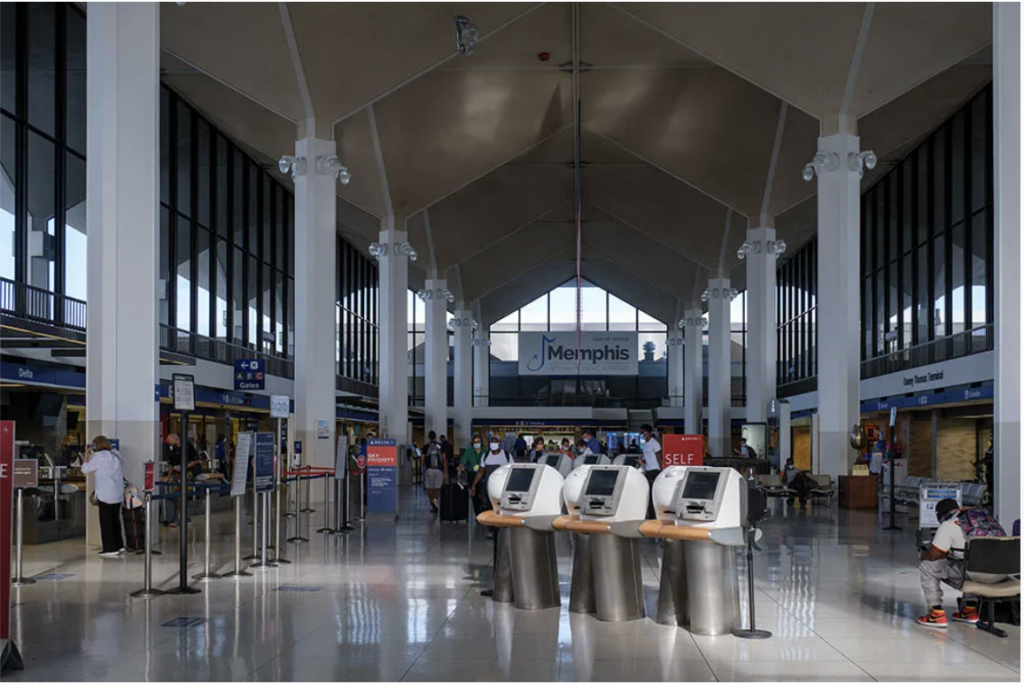
Memphis International Airport
Memphis has been modernizing its concourses through a program totaling over $500 million. As part of the Concourse B work, the airport selected TRAX to run eight restrooms on a loop that starts with passenger throughput and ends with a quality control check.
A modernized concourse, and restrooms that clean on demand rather than on the clock.
Memphis International Airport has been actively renovating and modernizing its concourses, with ongoing projects totaling over $500 million. In late 2021 Memphis selected TRAX Analytics as its technology provider to support passenger experience as part of the Concourse B modernization program.
TRAX proposed and installed a SmartRestroom deployment across eight restrooms, made up of throughput monitoring, custodial monitoring with Bluetooth badges, and the TRAX mobile app.
Throughput and restroom usage data is a crucial metric for Memphis, because it is what tells the airport how passenger trends are moving and what that means for cleaning frequencies and labor.
The Challenge
A half-billion-dollar modernization program raises the standard for everything inside it, including the parts passengers judge fastest. A newly rebuilt concourse with restrooms cleaned on a fixed rotation gives back some of what the investment just bought.
Memphis also needed the labor question answered with data rather than assumption. Passenger trends move, and cleaning frequencies and staffing that are set once and left alone will be wrong in one direction or the other for most of the year.
The Solution
TRAX installed throughput monitoring across eight restrooms, along with Bluetooth badges for custodial monitoring and the TRAX mobile app. The pieces work as a loop rather than as separate reports.
When a throughput counter alerts supervisors that a location needs service, frontline team members carrying Bluetooth badges are dispatched. The badge passively registers the time and date of the cleaning and who carried it out — no scanning, no logging, no extra step on the route. When they leave, supervisors can run a quality control check on the work to confirm the standard was met. Once that is done, the throughput counter clears its alert and the system prioritizes the next location.
The platform consumes throughput data, cleaning data and quality control information together, which is what makes historical analysis of the operation possible. The airport can view live dashboards showing the status of each restroom, whether it is being serviced or when it was last serviced, and every open quality control follow-up.
What TRAX deployed
- SmartRestroom across eight restrooms as part of the Concourse B modernization program
- Throughput monitoring at each restroom location
- Bluetooth badges for passive custodial monitoring — time, date and who carried out the cleaning
- The TRAX mobile app for the frontline team
- Quality control checks completed after service, feeding back into the alert loop
- Live dashboards showing restroom status, last service time and open quality control follow-ups
- Historical analysis across throughput, cleaning and quality control data on one platform
The Benefits
- Cleaning triggered by actual passenger usage rather than a fixed rotation
- Proof of service captured passively by badge, with nothing added to the frontline team's route
- Alerts that clear only after the work is done and checked, so the queue reflects reality
- Automatic prioritization of the next location, so supervisors direct rather than triage
- Passenger trend and labor-need analysis grounded in throughput data the airport owns
The deployment has been running since October 2021 across eight restrooms in the modernized Concourse B, on a one-year contract that renews annually. The airport uses throughput, cleaning and quality control data together to monitor passenger trends and set cleaning frequencies and labor levels.
READY WHEN YOU ARE
Match cleaning frequency to passenger volume
See how TRAX helps airports move from schedule-based cleaning to demand-based cleaning.