
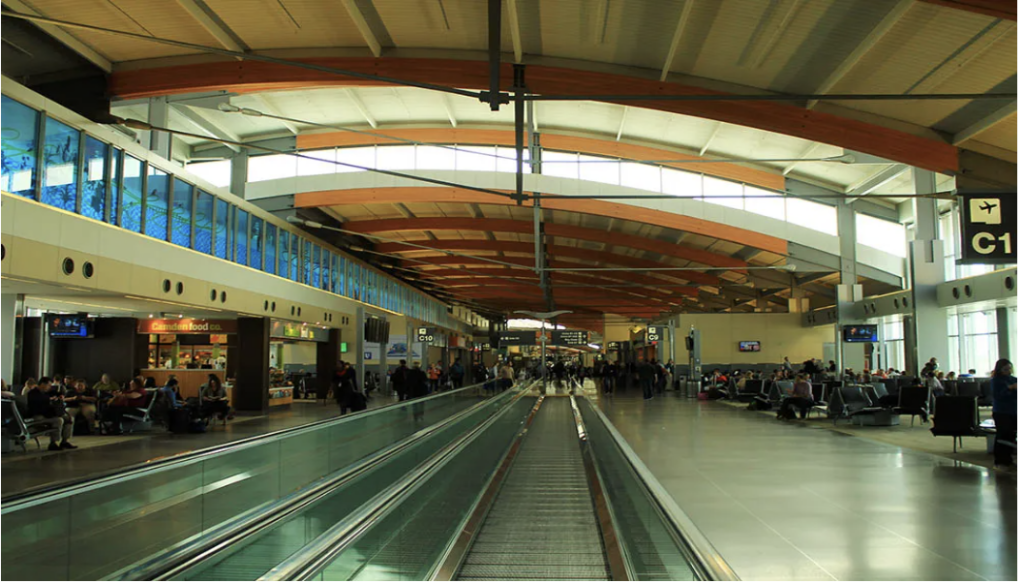
Raleigh Durham International Airport
Flagship set out to run RDU on a hybrid model — part scheduled, part demand-driven. Thirty passenger-facing restrooms were fitted with a throughput counter, a proximity beacon and passenger feedback capture. The whole installation took under three hours.
Three technologies per restroom, thirty restrooms, under three hours.
Raleigh-Durham International Airport has two terminals and serves thirteen airlines. RDU selected Flagship Facility Services to provide janitorial services airport-wide, covering office space, gates, restrooms and all passenger-facing areas.
Flagship contracted TRAX Analytics for Clean+Inspect and SmartRestroom to support a specific goal: a hybrid janitorial model combining schedule-based and demand-based cleaning.
The install is worth pausing on. Thirty restrooms, three technologies in each, and the whole thing took less than three hours — which is the answer to the question every airport operator asks first about deploying anything into a live terminal.
The Challenge
A purely scheduled cleaning model cannot respond to a flight bank, and a purely demand-driven one leaves the routine work unaccounted for. Flagship wanted both running together, which requires a live read on restroom usage and a way for the schedule and the alerts to live in the same system.
Flagship’s scope also went well beyond restrooms — office space, gates and all passenger-facing areas — so quality control had to cover assets across the airport, not just the places with sensors in them.
And it had to go into an operating terminal without a disruption anyone would notice.
The Solution
TRAX fitted sensor technology at each of the thirty passenger-facing restrooms and put the mobile app on iPad tablets for the frontline team. Each restroom received a battery powered throughput counter to monitor passenger usage, a proximity beacon to register check-in and check-out times, and a mix of QR codes and NFC stickers on custom signage to capture passenger feedback on the state of the restroom. The full installation took less than three hours.
Clean+Inspect and the SmartRestroom deployment run in parallel, so Flagship supervisors schedule labor, cleaning work, inspections and project-based work while watching usage in real time on live dashboards. Triggers were set so the frontline team is alerted the moment a restroom passes a set passenger count or receives negative feedback — which is the hybrid model in practice rather than in theory.
Supervisors use the Inspect module for quality control on the restrooms and the cleaning work, and on elements and assets airport-wide. If something does not meet Flagship and RDU’s standard, the supervisor takes images and video of the asset or the work and opens and assigns a cleaning work ticket on the spot.
All of it is held in the TRAX platform, so Flagship and RDU can analyze the operation whenever they want. Historical and real-time analysis is what the executive teams use to understand labor needs, passenger trends and which areas need more frequent service.
What TRAX deployed
- Clean+Inspect and SmartRestroom supporting a hybrid schedule and demand-based cleaning model
- Sensor technology across all thirty passenger-facing restrooms, installed in under three hours
- A battery powered throughput counter in each restroom to monitor passenger usage
- A proximity beacon in each restroom registering frontline check-in and check-out
- QR codes and NFC stickers on custom signage for passenger feedback
- iPad tablets running the mobile app for the frontline team
- Alert triggers set on passenger count thresholds and on negative feedback
- Quality control inspections on elements and assets airport-wide, with images, video and work tickets assigned in real time
The Benefits
- Scheduled work and demand-driven alerts running in one system rather than two
- Passenger feedback captured by QR code and NFC on signage, with no tablet to install or maintain
- Alerts triggered by passenger volume or by negative feedback, so the frontline team responds to whichever comes first
- Quality control extended beyond restrooms to assets across the airport
- A failed inspection that becomes an assigned work ticket immediately, with photo and video attached
- Installation completed in under three hours across all thirty restrooms
The deployment has been running since November 2021 on a five-year contract, covering thirty passenger-facing restrooms and quality control across assets airport-wide. Flagship and RDU use historical and real-time analysis from the TRAX platform to understand labor needs, passenger trends and which areas need more frequent service.
READY WHEN YOU ARE
Run scheduled and demand-based cleaning together
See how TRAX supports hybrid janitorial models for facility service companies at airport scale.