
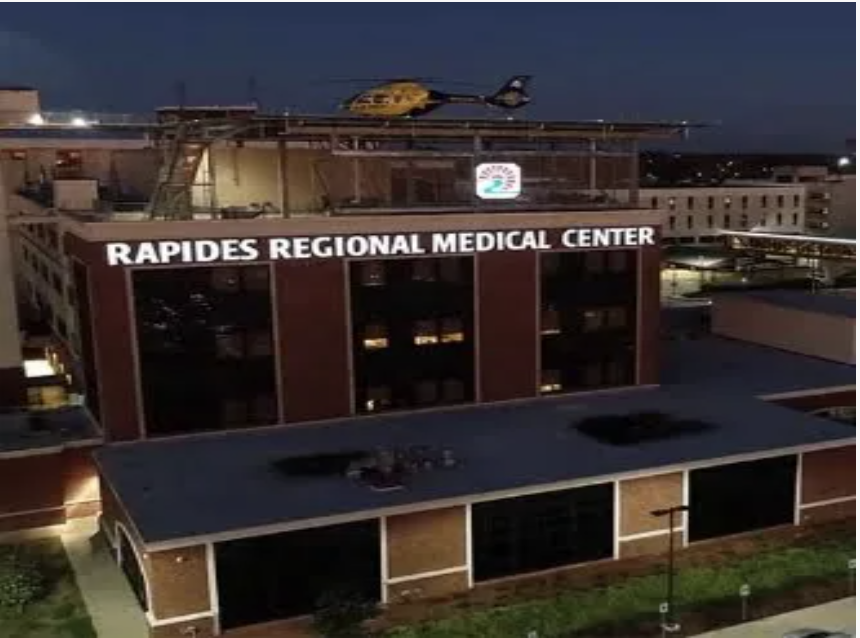
Rapides Regional Hospital
In a hospital, a restroom that needs attention needs it now. Rapides Regional Hospital put connected dispensers, throughput counters and feedback tablets behind its cleaning schedule, and moved from cleaning on a rotation to cleaning on demand.
Cleaning on demand, in a building where the standard is not negotiable.
Sanitation is a core part of operating a medical facility, and when an area needs service the response has to be immediate. For large facilities and medical networks focused on patient health and wellbeing, building a stronger cleaning process comes down to having the right tools behind it.
Rapides Regional Hospital began an ongoing contract with TRAX Analytics to deploy SmartRestroom across the hospital and improve cleaning processes throughout the facility.
The hospital came in with three specific goals, not a general wish to be cleaner — which is why the results are measurable.
The Challenge
Rapides set out three goals at the start. First, to analyze feedback trends by location, so the hospital could see both the facility-wide picture and what was happening in one specific restroom. Second, to identify reliable restroom traffic patterns and schedule custodial services against them rather than against a fixed rotation. Third, to track inventory accurately using connected dispensers, so high-usage items could be monitored and the facility would not run low.
Those three are related. Without traffic data the schedule is guesswork, without location-level feedback there is no way to tell whether the schedule is working, and without consumable data a perfectly timed cleaning still fails if the dispenser is empty when someone reaches for it.
The Solution
The SmartRestroom deployment gave Rapides visibility of consumable levels facility-wide, through smart soap dispensers, smart paper towel dispensers and smart toilet paper dispensers. Inventory needs became something the hospital could analyze rather than estimate.
Thermal throughput counters and survey feedback tablets identified the hospital’s peak restroom usage times: 9am, 11am, 12pm and 4pm. Paired with the TRAX mobile app on iOS, that let the environmental services team schedule cleaning at the times the data actually pointed to. The predictive analytics capability continues to sharpen that scheduling as more data accumulates.
The feedback tablets do double duty. They collect the trend data the hospital wanted by location, and they capture responses to the improvements as they are made — so the effect of a schedule change shows up in the same system that prompted it.
What TRAX deployed
- SmartRestroom deployed across the hospital facility under an ongoing contract
- Smart soap, paper towel and toilet paper dispensers reporting consumable levels facility-wide
- Thermal throughput counters measuring restroom usage
- Survey feedback tablets capturing responses by location
- The TRAX mobile app on iOS for the environmental services team
- Peak usage times identified at 9am, 11am, 12pm and 4pm
- Predictive analytics to keep refining cleaning schedules as data accumulates
The Benefits
- Cleaning scheduled against measured peak times rather than a fixed rotation
- Feedback trends readable by location, so a problem in one restroom does not disappear into a facility average
- Consumable levels visible facility-wide, so dispensers are refilled before they run out rather than after someone reports it
- Inventory demand that can be anticipated from reports instead of reacted to
- A closed loop — usage drives the schedule, feedback measures the schedule, and both sit in the same platform
Rapides Regional Hospital achieved a positive feedback score of 88% and a survey utilization rate of 9.5%. In the last six months, the hospital’s environmental services team completed more than 9,000 cleaning work tickets through the TRAX mobile app. The hospital now runs a data-driven, demand-based cleaning operation powered by real-time feedback, restroom usage and live tracking of consumable levels.
READY WHEN YOU ARE
Bring demand-based cleaning to your facility
See how TRAX helps healthcare environmental services teams schedule against real usage and document the result.